
Understanding everyday experiences of Vulnerability and Resilience in urban Latin America
Creative Vulnerabilities is a collaborative repository dedicated to sharing narratives from empirical qualitative research conducted with vulnerable populations in urban Latin America.
Our platform aims to shed light on the experiences and insights gathered through qualitative studies, offering a space for meaningful dialogue and understanding of what it means to be vulnerable in urban Latin America.
Researchers, community members, practitioners, activists, artists, policymakers or any other working with vulnerable populations, are invited to submit narratives that capture how individuals and communities face, confront and live with their vulnerabilities.
Latest Urban Narratives

Facing crime and heat "bit by bit"
Cristhian Figueroa
Assistant Professor
Universidad Tecnológica Metropolitana
She is nearly 50 years old, has a partner, and has three children: two adult daughters and a young son. She lives in a neighbourhood on the outskirts of Santiago. She lives in fear.
Santiago, Chile, Women, Poverty, Climate change

This is Mariana, she not afraid of anything
Gabriela Piña
Assistant Professor
Universidad Mayor
When I met Mariana, she was a nine-year-old force of nature. The third of four siblings, she was introduced to me by her younger sister Silvana, six at the time, who, with a serious expression, pointed at her and said “This is Mariana, she is not afraid of anything.”
Rural/urban, Boarding Schools, Indigenous Children

Dancing communities: uniqueness and belonging for a non-binary trans migrant
Thi Bogossian Porto & Arevik Bogossian Porto
Teaching Fellow, Postgraduate Student and Clinical Psychologist
University of East Anglia & Universidade Federal da Bahia
“This is such a brave thing to do. Do you feel brave?” Upon first arriving in Salvador from their hometown in Rio de Janeiro, Arevik felt they were now free to seek practices to align their body with their vision of self-transformation towards a trans-non-binary individual.
Transgender, Belonging, Creativity, Salvador (Brazil)

Between kitchens and commutes: mobility in domestic work in Mexico
María Teresa Ramírez Figueroa
PhD Student
Universidad Nacional Autónoma de México
Angie has worked for more than twelve years in the domestic work sector in the Metropolitan Area of the Valley of Mexico. She began as a cleaning employee and, over time, moved up to become a cook—a better-paid position that she learned on the job.
Domestic work, Urban Mobility, Spatial Inequality

For our health and communities' contribution to climate change adaptation in urban areas
Marisol Suárez-Roldán
Researcher in Climate Change and Health
Universidad de Antioquia
In the Valle de Aburrá, a sub-region of the department of Antioquia, Colombia, a diverse group of people meets periodically with a clear purpose: to transform their territory to protect human and environmental health.
Health, Gardens, Climate Change, Salud Mental, Huertas, Cambio Climatico

"Victimhood is not my thing:" a life of resilience on the margins
Antonia McGrath
PhD Candidate
University of Amsterdam
Nahomy grew up on the outskirts of El Progreso, Honduras. "Honestly, I spent most of my childhood on the streets, the neighbours used to give us food because my parents didn’t cook," she recalls.
Honduras, Youth, Resilience

The armored door
Felipe Barrientos
PhD Candidate
Université Paris cité
After attending one of the schools in Estación Central for a couple of months, I was finally able to delve deeper into certain themes related to urban space. I entered the field in the role of an analogue photography teacher. Each session included me and roughly eight or nine other students, all between the ages of 12 and 13.
Migration, Photography, Methodology

We are here, we are the data: the Geração Cidadã de Dados collective in Rio de Janeiro and the right to be seen
Tainá Farias da Silva Maciel
Postgraduate Researcher in Urban Studies
Universidade Federal do Rio de Janeiro
In the early 2010s, Rio de Janeiro was internationally hailed as a model of the “smart city.” Yet, in the shadows of this hyper-connected city, another Rio persisted.
Data Activism, Basic Sanitation, Socio-spatial Justice

Notes from a day in the field
Felipe Baeta Casula Pereira
Student and Undergraduate Research Assistant
Universidade Federal de Minas Gerais
The instructions were: if the location designated for the survey is in a high-risk area, request a relocation from Antônio (the field research coordinator).
Ageism, Unequal Ageing Experience, Elderly Mobility
Elderly people: a heterogeneous group moving (or not) through the Metropolitan Region of Belo Horizonte, Minas Gerais (Brazil)
Eli Martins Venancio
Undergraduate Student in Social Sciences
Universidade Federal de Minas Gerais
If you walk around the Metropolitan Region of Belo Horizonte, you’ll quickly realize ageing is not a process that affects everyone equally. Factors like gender, race, and class shape the experiences of people aged 60 and over.
Social Categories, Urban Mobility, Older People

Voices from the Casa Hogar. Sara’s Story: The Girl Who Wanted to Teach Her Father
Ana Karen Reyes-Bailon
PhD Candidate
University of Leeds
Sara and her sister (aged 7 and 6 respectively) stayed at the casa hogar during the week while their parents worked, her mom cleaned houses, and her dad worked in construction. When I first met Sara in the classroom, some of the children approached me with questions. Others watched from a distance.
Urban Vulnerability, Indigenous Youth, Resilience

Aspiring in precarious spaces
Heidi D. Mendoza
PhD Researcher
Vrije Universiteit Amsterdam
“But who would like to live there, along the river?” the engineer asked several times. I worked with the engineer for my fieldwork, but he found it difficult to understand what a human geographer would find out from working with the riverine communities close to the city.
Aspirations, Contention, Rivers
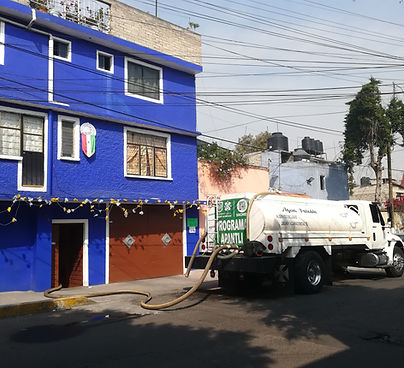
Hey neighbour, do you have water?
Andrés Emiliano Sierra Martínez
PhD Researcher
University of Sheffield
Every morning is the same for Julia. She wakes up around four and opens the water tap. Then comes a wave of anxiety through her body: she never knows if water will come out.
water scarcity, neighbour-based organisations, environmental justice
In the face of vulnerability, we discover our strength; it's in the cracks of our circumstances that resilience shines brightest.

Stay Updated
Receive the latest narratives directly to your inbox.